This article starts with general information and slides downhill into more technical information about our radios and antennas for ham radio. Simply stated, we use amateur radios for the following:
communicating between ourselves when we're backing the trailer,
communicating between ourselves when we're separated away from our truck or trailer,
for automatic access to emergency notification of imminent weather change from NOAA,
communicating with friends nearby or far away,
participating in scheduled nets nationwide or regionally
maintaining our preparedness for potential cellular communication failures,
having fun experimenting with maximum distance (for us) contacts with ham operators overseas.
This article explores the equipment we use and some of the issues we've faced in learning and setting up these systems.
Two updates - we replaced the Yaesu FT60r with an FT25 in 2018. And we found, sort of, the flaw in our position location system. This is called APRS and sends out our location data via ham radio to internet. August 2018, mid-journey, our APRS radio stopped transmitting our location data. It took awhile but Jim finally contacted Kenwood for help. They very helpfully suggested he "reboot" the radio, try the function again, and if it didn't work then send the radio to their California repair center. Heck! Why didn't we think of resetting the radio? Sure enough, the radio works perfectly now.
A friend suggested recently we try out cross-band repeat on our Kenwood mobile radios. This is a capability of our 710 and V71 mobile 2m/70cm radios to act as a repeater. It would allow us to use our far weaker handheld (HT) radios to talk to each other through the mobile then back to the other HT or through the mobile to a local repeater. We could use this at rallies or our mountain property sometimes. Jim enthusiastically set about figuring out how to do it. Then he realized with disappointment our HTs are both single band 2m units, and we'll need dual band HTs to implement this cool function. Maybe later?
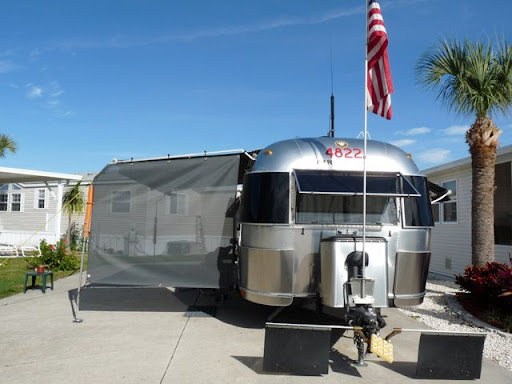
We're full-timing in an Airstream trailer and traveling throughout North America. We sometimes are pretty far off the main track. Could we implement a reasonable communications system in lieu of cell (or satellite) phones in case we have an emergency, need to report something, or want to assist in an emergency? Yes! Ham radio can meet these requirements. We first became interested in amateur radio as back-up communications for full-timing travels.
Sometimes we experience loss of cell phone signal, sometimes for days. CB radio is reliable up to as little as one to four miles. Ham (amateur) radio has send and receive capability for everything from local to over six thousand miles distant. We decided amateur radio capability for requesting assistance or information, when other means fail, might be a good backup communications mode.
After we obtained our Technician class licenses in 2006, a friend gave us an old Icom hand held radio. It needed repairs. We knew nothing about mini- or micro-electronics (we later repaired it with a little help from Deb's dad and used it several years before passing it along to a new ham). Our first purchase was a Yaesu FT60R handie-talkie from Ham Radio Outlet as well as a mag-mount one-quarter wave antenna for the car roof to connect the portable radio when in the car or truck. Okay, now whom do we talk to?
Most communities have Amateur radio clubs and weekly two meter emergency nets. Local hams gather for a moderated net discussion and practice. Jim enjoyed the Charlotte, NC, W4BFB Club's helpful and friendly group of operators. The "formal" section of the net is not too formal but is affable and friendly (unfortunately this is not true of some amateur radio nets). Jim practiced radio communication weekly when we were in town and enjoyed attending the monthly club meetings. Amateur radio -- Now we're talking.
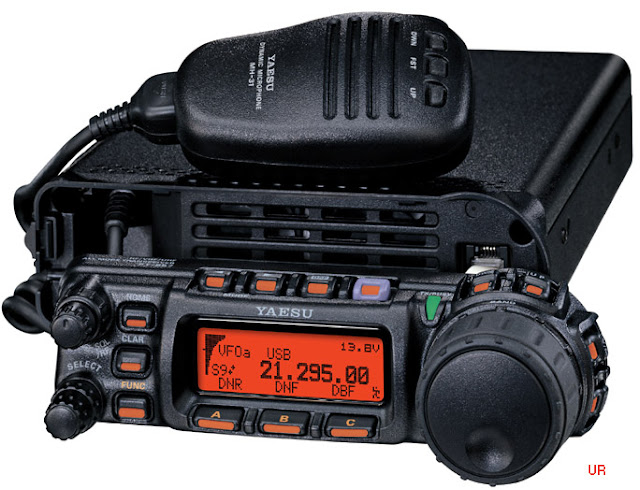
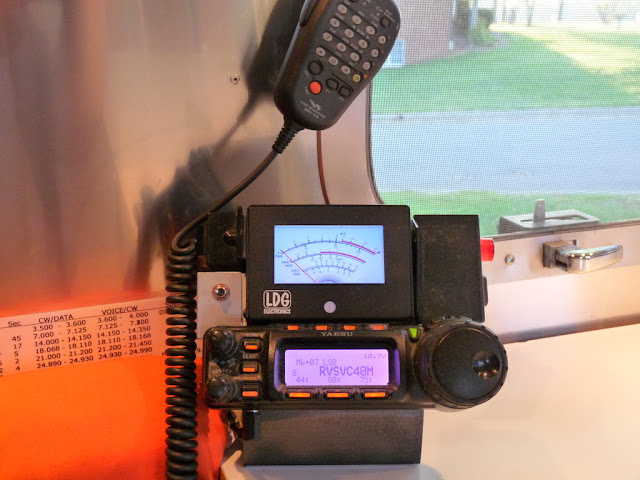
Jim became interested in longer range amateur radio communications. Two meter (VHF) amateur radio communications is generally limited to short range simplex use and local repeater range of approximately 25-50 miles radius. He studied and passed the General class exam to allow use of most of the HF bands. Okay, he needs another radio and more antenna than the UHF/VHF mag-mount. We bought a G5RVjr dipole wire antenna (very portable), and an ultra-compact mobile HF/VHF/UHF radio, the Yaesu FT-857d.
You might have read in our journal about transporting a friend's RV and truck from Bakersfield, California, to Belmont, NC? [see that story here]. Our mobile amateur radios played a big part in safety and our enjoyment on the trip. We talked across the country with the amateur radios to each other and with other hams as we drove over 2,500 miles in nine days. We already had the Yaesu 857d radio in our tow truck.
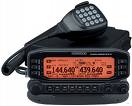
Jim installed another radio, a Kenwood TM-D710a, in Jerry's truck temporarily. This provided us much stronger radio capability than CB radio. We can talk miles apart and we can talk to other amateur radio operators as we cross their part of this great country. On a later trip we talked on our truck's 2m mobile radio to a friend in his truck 45 miles away.
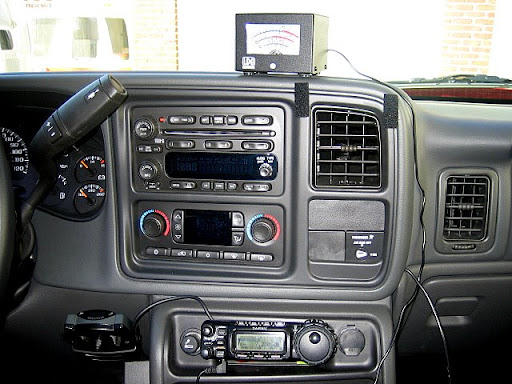
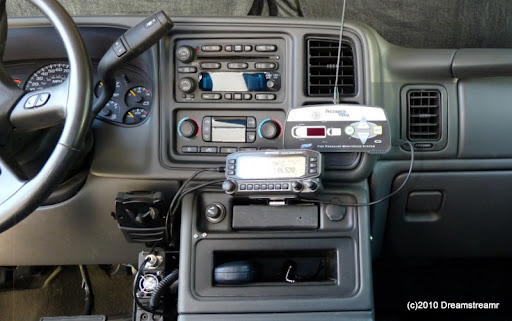
Late in 2008 we relocated the Yaesu 857d radio into the RV and the Kenwood TM-D710a into the dash of our truck (see Alan k0bg's helpful ham radio site for Safe Mobile Operation article). Jim also tried a 1/4 wave Larsen 270 antenna on the trailer roof for 2m and 70cm bands, then swapped to a Hustler LM270 for better SWR and put the Larsen 270 antenna on the truck. Funny, the two antennas each showed very different SWR readings on the truck and trailer.
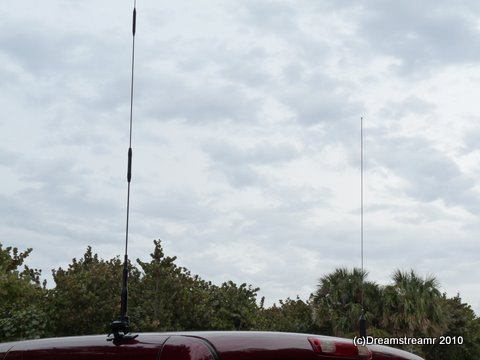
The little 18" 1/4 wave antennas are convenient and cute but just cannot compare to a well-tuned longer antenna. The 1/4 wave UHF/VHF on our truck's roof often seemed to perform poorly, perhaps because it was in the Airstream trailer's shadow. We changed first to a Comet SBB7/nmo 58" dual-band UHF/VHF for the truck in 2009 and then to a Larsen NMO2/70B 5/8 wave antenna. We often communicate simplex at fifteen (15) miles, have had clear simplex conversation (truck to truck) at up to 45 miles over flat ground, and have reached much farther to elevated repeaters. A great solution for our mobile communication!
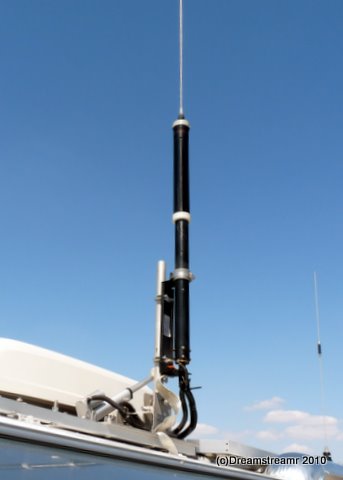
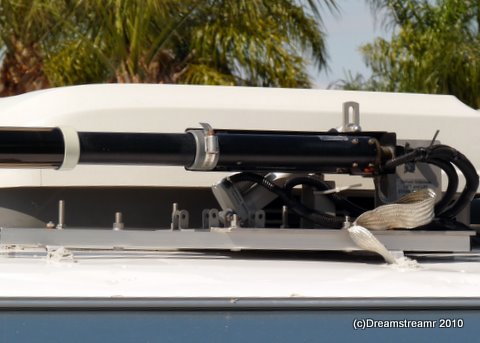
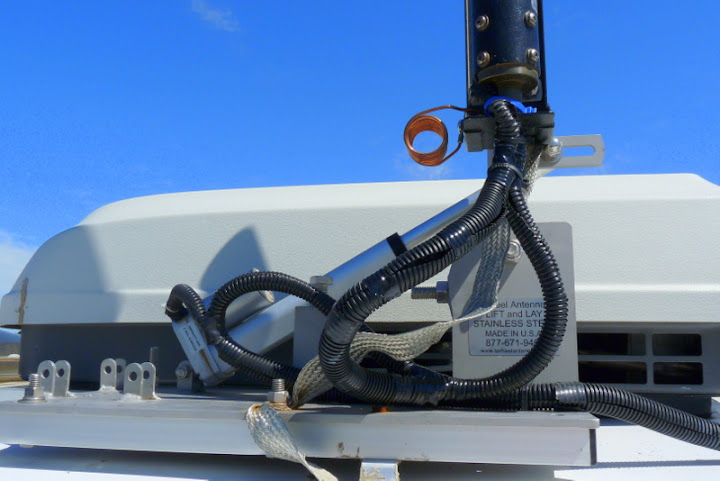
We have several good HF antenna choices on the road. The best, for several reasons, is a 68' end-fed wire (14ga stranded insulated) pulled up into a tall tree. I'll cover why it works well in the next paragraph. The next best is our High Sierra 1800Pro roof-mounted multi-band antenna on the roof of our Airstream trailer. The High Sierra HS1800Pro antenna is attached to a Tarheel Lift n Lay motorized fold-over mount to store the antenna flat against the trailer's roof or raise it ninety degrees up. The whip extends to 20 feet above ground, high enough to see over nearby trailers, fifth wheels, and motor homes. The third choice, and sometimes the best one, is our G5RV dipole antenna when we can pull it up between nearby trees. We tune it through an MFJ mobile manual tuner. Once we determine the settings for each band this arrangement provides pretty rapid band switching and works well. It's the slowest to construct but set up correctly has the best signal reception and transmission.
The end-fed wire feeds through an SGC autocoupler using the trailer's aluminum roof as an elevated ground plane. You just can't lay out enough radial ground wires to compare to an 8' X 23' aluminum roof. A pair of MFJ bias-tee voltage injectors feed 12vdc through the coax from the antenna switch under our dinette to power the autocoupler. We get almost instant band switching with great matching on all bands from 10 meters to 40 meters. Jim likes using this setup best although it requires an hour or two to rig the end-fed wire antenna and the autocoupler.
The screwdriver antenna has been great although it takes much more time and concentration to retune when switching bands. The antenna originally didn't work at all on 80 meters. It took almost two years for Jim to resolve, but he finally figured out how to stretch our HS1800 antenna to 80 meters. It has always done great on the higher bands but couldn't provide a workable SWR for 80 until June 2010. What changed? One Sunday morning Jim was reading ARRL's Handbook, great and interesting reading for quiet times, and found a fine article on mobile HF antenna matching.
The ARRL Handbook article described the pitfalls of antennas associated with poor matching and the requirement to properly adjust the antenna's shunt coil. And the Handbook referenced a particular article by Alan K0BG. Inquisitive, time on his hands, and with nothing to lose, he checked out K0BG's article. Wow, this looks hopeful!
This article disclosed what Jim may have been missing all along. He had wondered why the otherwise excellent High Sierra antenna wouldn't transmit on 80 meters. A few minutes into K0BG's well-written article on mobile radio and antennae and Jim found a quick and easy test to perform. Sure enough, his antenna just wasn't set up properly for 80 meters.
Fortunately, K0BG also provides detailed instructions on how to correct an HF antenna's matching problem. Jim followed Alan's instructions and a few hours later he's in business. An added bonus, his much larger than oem home-made shunt coil looks superb up there. Cool! Thanks, Alan K0BG.
We are able to communicate on 12, 15, 17, 20, 30, 40, 60, and 80 meters with the High Sierra antenna. We are often able to communicate on the nation-wide RV Service Nets on 20 meters and 40 meters. The RV Service Net holds nets across the U.S. on 40 meter bands and is open to all RVers regardless of RV brand. Look it up here, it is a great club for anyone interested in RVing or amateur radio. We also check into MidCars and SATERN HF nets when we can.
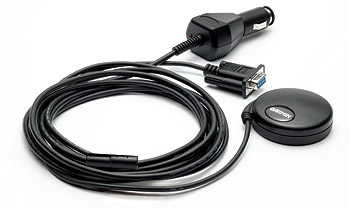
Early 2010 we added a GPS18pc puck in the truck to tell the Kenwood 710 VHF/APRS radio our location. Our position is now updated when we're on the move, and you can see where we are according to our last reported position here.
Early 2012 we added a Kantronics KamXL radio modem (TNC) to the trailer's radio setup. This, connecting a laptop computer and the ham radio, allows sending emails to designated amateur radio stations throughout North America for relay to your intended target. It allows us to send and receive emails without ever being within range of internet ourselves. Also we can download regional weather forecasts for any part of the continent any time. Way cool! Sometime along the way we lost the connectivity on the Kantronics modem and haven't spent time to reestablish it.
We have found amateur radio operators to be much like RV owners, friendly and very helpful. We also found a fun group of hams within WBCCI, the WBCCI Amateur Radio Club and RV Service Net members. We meet several times a year at various ralllies, helping one another with antenna or power or radio issues, catching up with one another, and comparing our newest equipment changes.
We bought another HF radio, an old Kenwood 450SAT, while at Hamcation (Orlando FL) Feb 2011. Jim enjoys working with a "real" HF radio. The Yaesu 857d is great for super-compact installation as we need. But the bigger radio is just easier to use with a full complement of dials and buttons in lieu of the 857's sub-menus. Only problem we have is finding a place for the Kenwood -- it isn't really suitable for full-time set-up in a 25' travel trailer. Kind of like looking for a portable antenna tower for the truck and trailer -- we're limited on what we can take along.
We had a weather alert portable radio that wouldn't receive well inside the trailer and had battery life issues, was difficult to program new SAME codes each time we relocated to another area. Solution? While we were at Hamvention in Dayton May 2011, Jim bought another mobile vhf/uhf radio. A Kenwood TM-V71a mobile dual-band radio with weather alerts and removable face is just the ticket. Jim mounted the new radio in the truck and put the 710a under the dinette beside the 857d and placed the Kenwood head unit above the 857d's head unit. Looks great, and works perfectly. If there's any way to reach NOAA alert stations, we can quickly and easily configure to automatically receive up to two. This has worked out really well.
Jim has had two-way radio contacts from our trailer with amateur radio operators in over twenty-five countries and many U.S. states from Hawaii to Maine, Washington to Florida. We've made good friends, many of whom we we've met in person, in different parts of the continent through amateur radio. Pretty cool! And we know we are capable, from anywhere in the world, of communicating with other amateur radio operators to give or receive assistance when needed.
When All Else Fails, Amateur Radio!
Amateur radio just seemed like a good idea to support our potential communications needs when traveling off the beaten path. We weren't looking for a hobby and didn't intend this to become one. But Jim has a lot of fun exploring the radio waves, meeting people all over the world on radio, and continuing to learn every day.
For more information about amateur radio and how you can get started, email us or go to ARRL's website here